You don’t really need an introduction to POSH anymore. Every organisation has a policy. Every employee has signed it at some point. There are trainings, awareness sessions, emailers, posters in office corridors. On paper, everything looks exactly the way it should.
And yet, every few months, something breaks through the surface. A controversy, a complaint, a story that refuses to stay buried – whether it’s around companies like Tata Consultancy Services or policy discussions triggered by Lenskart. For a few days, everyone talks about workplace harassment again. Opinions fly. People take sides. And then, just like that, it fades.
But what doesn’t fade is what actually happens behind closed doors.
I’m not saying this as someone reading headlines. I’m saying this as someone who has been on the other side of the table. Part of Internal Committees under as an external member. The law itself is not confusing. It draws from the Vishaka Guidelines, it has structure, timelines, defined processes. It tells you exactly what is supposed to be done.
And that’s precisely why what actually happens feels so uncomfortable.
Because the problem is not that we don’t know what to do. The problem is that we often choose not to do it.
You sit through these inquiries and you start noticing a pattern. Not immediately, but gradually. A complaint comes in. It is serious enough to trigger the process. There is documentation, sometimes messages, sometimes behaviour that is not even subtle. And still, somewhere along the way, the conversation shifts. It stops being about what happened, and starts becoming about what should be done about it.
And that shift is everything.
Suddenly, the focus is no longer the complainant. It becomes the organisation. Its image. Its people. And its “culture”. Words like fairness, balance and sensitivity start floating around. On the face of it, they sound correct. Who would argue against fairness?
But fairness, in practice, often becomes dilution.
And this is not limited to POSH alone. Even outside sexual harassment complaints, in general grievance mechanisms or internal complaints of misconduct, the pattern is eerily similar. The moment an issue begins to look like it can disturb internal harmony or create reputational discomfort, the system quietly begins to push back.
Not against the issue.
Against the person raising it.
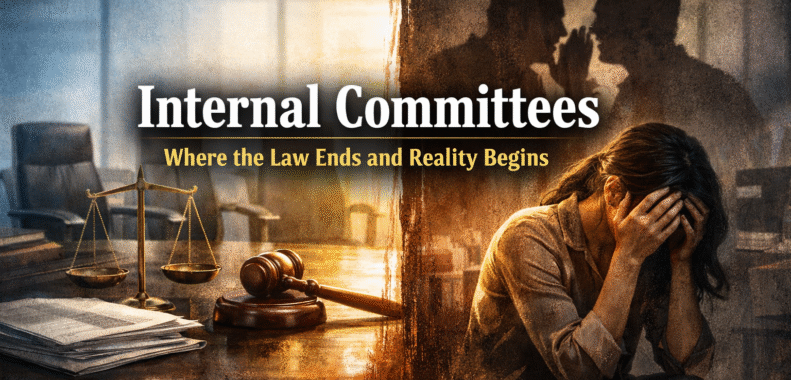
The Internal Complaints Committee, aka the ICC, was meant to be an independent body. Neutral. Unbiased. A space where facts are examined without fear or favour. But independence on paper and independence in practice are two very different things.
Because the ICC does not function in isolation. It exists within the organisation. It is appointed by the organisation and it is, directly or indirectly, answerable to the organisation. And that subtle but constant presence changes how things unfold.
No one openly says, “protect the organisation”. It doesn’t work like that. It comes wrapped in softer language.
“This could escalate unnecessarily.”
“We should be careful about reputational impact.”
“Let’s not take a step that is too harsh.”
And slowly, without anyone admitting it, the inquiry starts drifting towards the least disruptive outcome.
I have seen situations where there is clear evidence – of stalking, of repeated unwelcome behaviour, of lines being crossed not once but multiple times. And yet, the final finding lands on “not enough to establish guilt”. Or the organisation quietly terminates the person without ever mentioning the real reason.
It looks clean. It looks controlled. And it looks like due process has been followed.
But it feels incomplete.
Because what really happens in that moment? The person against whom the complaint was made walks away without ever being held accountable for what they actually did. The complainant walks away having gone through a process that questioned them more than it protected them. And the organisation walks away successfully after containing the situation.
Everyone moves on. Except the problem.
And over time, you start noticing something else. A certain hesitation. People think twice before complaining. Not because they don’t know the mechanism exists, but because they know how it plays out. There is a quiet understanding that raising an issue is not just about what happened, it is about what it will cost you, which will not be limited to your complaint being dismissed but may also result in your own termination or further harassment in the form of PIP and other modes.
Because somewhere along the way, complainants start becoming “difficult employees”. People who “create issues”. People who “don’t align with culture”.
And organisations, more often than not, do not like employees who disturb internal equilibrium.
Reputation, at the end of the day, sits above everything else.
We like to believe that we are being humane when we “give someone another chance”. But what we are actually doing is something else entirely. We are telling the complainant that what they experienced is negotiable. We are telling the accused that the consequences are manageable. And we are telling ourselves that this is what neutrality looks like.
It isn’t.
Impartiality was never meant to mean hesitation, it was meant to mean fairness rooted in facts. But somewhere along the way, we started confusing impartiality with discomfort in taking a stand.
And that discomfort shows.
Because the truth is, real enforcement is not neat. It’s messy. It affects careers. It creates internal friction. And it forces organisations to acknowledge that something went wrong within their system. And most organisations are not built to willingly accept that.
So they comply. They form ICCs. They conduct POSH trainings. And they even circulate policies. Everything that can be documented is done.
And when it actually comes down to a decision that requires clarity, they pause.
Maybe that is the real problem. Not the law, not the framework, not even awareness.
Just the absence of intent.
Because if a complaint comes in, and there is enough to act on it, and the system still chooses the safer outcome, then what exactly are we protecting?
The organisation?
Or the illusion that nothing within it is broken?